
Fingerprints Can Reveal A Lot About Your Personality. Check Out What Yours Say
Fingerprints can reveal a whole lot of things about a person, like their intelligence, personality and talents, to name a few. Dermatoglyphics is a branch of science that is dedicated to the study of the mount, the ridges, and the lines that form your fingerprints.
There are 11 different types of Fingerprint patterns that have a few personality traits associated with them. Understand what your fingerprints reveal about you.
1. Simple Arch
A person with a simple arch fingerprint can be characterised as dedicated, committed, with a deep sense of loyalty. This makes them dependable and steady workers. They also tend to be introvert, and usually do not like taking risks.

2. Tented Arch
People with this fingerprint pattern are usually really confusing. They can be extremely welcoming one day, and completely uninterested the other. They are very creative and aren’t afraid of challenges. However, they can be very impulsive at times.

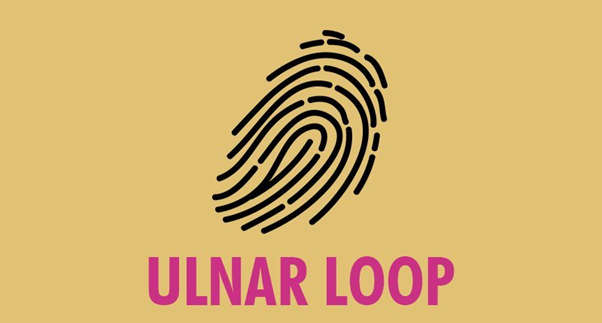
3. Ulnar Loops
People with this pattern are generally gentle, observant and passive. And they love going with the flow.
4. Radial Loop
People with a radial loop pattern tend to be self-centred and egocentric. They love to go against the majority, and question and criticise. They love their independence and are usually very clever.
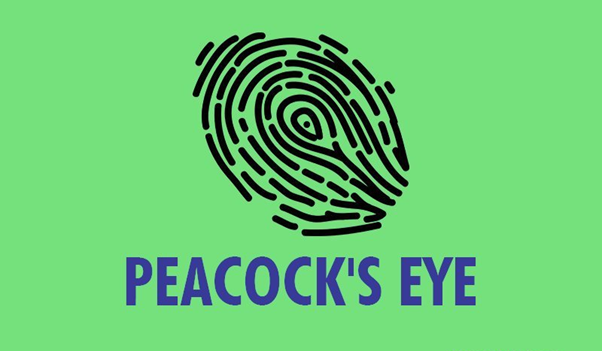
5. Peacock’s Eye
A person with a peacock’s eye fingerprint is considered to have excellent leadership qualities. They are extremely artistic and very expressive. They’re also considered to be highly perceptive.
6. Variant Patterns
People with such a complex pattern can usually offend people easily. Their way of expressing themselves is usually very unique which tends to put people off.

7. Press Whorl
People with this pattern are considered to be highly ambitious, and are also very competitive. With such characteristics, they hate to be defeated. They have an eye for detail, and are very well planned with their budgets.
8. Composite Whorl
People with such fingerprints are very good communicators. They have amazing coordination skills, and make decisions taking cue from the environment they are in, which makes them very adaptable. But they get distracted quite easily.

9. Spiral Whorl
People with this fingerprint pattern are very self motivated, and individualistic. They tend to love their solitude, which might make them seem a bit aloof, but really, they’re just trying to find their niche.
10. Imploding Whorl
A person with an imploding whorl pattern is usually very self-conscious, and a tiny bit shy as well. However, they are great at multi tasking and are very open minded.

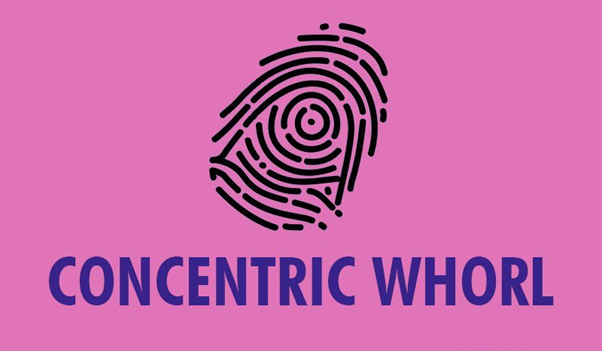
11. Concentric Whorl
People with this fingerprint pattern are usually self-loving. They love setting objectives for themselves, and hate being controlled in any way. Although, they are very subjectively sound people.
Fingerprint
A fingerprint is an impression left by the friction ridges of a human finger. The recovery of partial fingerprints from a crime scene is an important method of forensic science. Moisture and grease on a finger result in fingerprints on surfaces such as glass or metal. Deliberate impressions of entire fingerprints can be obtained by ink or other substances transferred from the peaks of friction ridges on the skin to a smooth surface such as paper. Fingerprint records normally contain impressions from the pad on the last joint of fingers and thumbs, though fingerprint cards also typically record portions of lower joint areas of the fingers.
Human fingerprints are detailed, nearly unique, difficult to alter, and durable over the life of an individual, making them suitable as long-term markers of human identity. They may be employed by police or other authorities to identify individuals who wish to conceal their identity, or to identify people who are incapacitated or deceased and thus unable to identify themselves, as in the aftermath of a natural disaster.
Biology
Fingerprints are impressions left on surfaces by the friction ridges on the finger of a human. The matching of two fingerprints is among the most widely used and most reliable biometric techniques. Fingerprint matching considers only the obvious features of a fingerprint.
A friction ridge is a raised portion of the epidermis on the digits (fingers and toes), the palm of the hand or the sole of the foot, consisting of one or more connected ridge units of friction ridge skin.[citation needed] These are sometimes known as “epidermal ridges” which are caused by the underlying interface between the dermal papillae of the dermis and the interpapillary (rete) pegs of the epidermis. These epidermal ridges serve to amplify vibrations triggered, for example, when fingertips brush across an uneven surface, better transmitting the signals to sensory nerves involved in fine texture perception.[3] These ridges may also assist in gripping rough surfaces and may improve surface contact in wet conditions.
Fingerprint Classification System
Before computerization, manual filing systems were used in large fingerprint repositories. A fingerprint classification system groups fingerprints according to their characteristics and therefore helps in the matching of a fingerprint against a large database of fingerprints. A query fingerprint that needs to be matched can therefore be compared with a subset of fingerprints in an existing database.[2] Early classification systems were based on the general ridge patterns, including the presence or absence of circular patterns, of several or all fingers. This allowed the filing and retrieval of paper records in large collections based on friction ridge patterns alone. The most popular systems used the pattern class of each finger to form a numeric key to assist lookup in a filing system. Fingerprint classification systems included the Roscher System, the Juan Vucetich System and the Henry Classification System. The Roscher System was developed in Germany and implemented in both Germany and Japan. The Vucetich System was developed in Argentina and implemented throughout South America. The Henry Classification System was developed in India and implemented in most English-speaking countries.[5]
In the Henry Classification System there are three basic fingerprint patterns: loop, whorl, and arch,[6] which constitute 60–65 percent, 30–35 percent, and 5 percent of all fingerprints respectively.[citation needed] There are also more complex classification systems that break down patterns even further, into plain arches or tented arches,[5] and into loops that may be radial or ulnar, depending on the side of the hand toward which the tail points. Ulnar loops start on the pinky-side of the finger, the side closer to the ulna, the lower arm bone. Radial loops start on the thumb-side of the finger, the side closer to the radius. Whorls may also have sub-group classifications including plain whorls, accidental whorls, double loop whorls, peacock’s eye, composite, and central pocket loop whorls.[5]
The system used by most experts, although complex, is similar to the Henry Classification System. It consists of five fractions, in which R stands for right, L for left, i for index finger, m for middle finger, t for thumb, r for ring finger and p(pinky) for little finger. The fractions are as follows:
Ri/Rt + Rr/Rm + Lt/Rp + Lm/Li + Lp/Lr
The numbers assigned to each print are based on whether or not they are whorls. A whorl in the first fraction is given a 16, the second an 8, the third a 4, the fourth a 2, and 0 to the last fraction. Arches and loops are assigned values of 0. Lastly, the numbers in the numerator and denominator are added up, using the scheme:
(Ri + Rr + Lt + Lm + Lp)/(Rt + Rm + Rp + Li + Lr)
A 1 is added to both top and bottom, to exclude any possibility of division by zero. For example, if the right ring finger and the left index finger have whorls, the fraction used is:
0/0 + 8/0 + 0/0 + 0/2 + 0/0 + 1/1
The resulting calculation is:
(0 + 8 + 0 + 0 + 0 + 1)/(0 + 0 + 0 + 2 + 0 + 1) = 9/3 = 3
Fingerprint Identification
Fingerprint identification, known as dactyloscopy,[7] or hand print identification, is the process of comparing two instances of friction ridge skin impressions (see Minutiae), from human fingers or toes, or even the palm of the hand or sole of the foot, to determine whether these impressions could have come from the same individual. The flexibility of friction ridge skin means that no two finger or palm prints are ever exactly alike in every detail; even two impressions recorded immediately after each other from the same hand may be slightly different.[citation needed] Fingerprint identification, also referred to as individualization, involves an expert, or an expert computer system operating under threshold scoring rules, determining whether two friction ridge impressions are likely to have originated from the same finger or palm (or toe or sole).
An intentional recording of friction ridges is usually made with black printer’s ink rolled across a contrasting white background, typically a white card. Friction ridges can also be recorded digitally, usually on a glass plate, using a technique called Live Scan. A “latent print” is the chance recording of friction ridges deposited on the surface of an object or a wall. Latent prints are invisible to the naked eye, whereas “patent prints” or “plastic prints” are viewable with the unaided eye. Latent prints are often fragmentary and require the use of chemical methods, powder, or alternative light sources in order to be made clear. Sometimes an ordinary bright flashlight will make a latent print visible.
When friction ridges come into contact with a surface that will take a print, material that is on the friction ridges such as perspiration, oil, grease, ink, or blood, will be transferred to the surface. Factors which affect the quality of friction ridge impressions are numerous. Pliability of the skin, deposition pressure, slippage, the material from which the surface is made, the roughness of the surface, and the substance deposited are just some of the various factors which can cause a latent print to appear differently from any known recording of the same friction ridges. Indeed, the conditions surrounding every instance of friction ridge deposition are unique and never duplicated. For these reasons, fingerprint examiners are required to undergo extensive training. The scientific study of fingerprints is called dermatoglyphics.
Fingerprint Verification
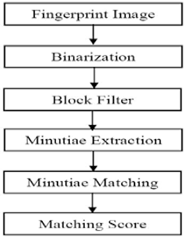
Fingerprints can be captured as graphical ridge and valley patterns. Because of their uniqueness and permanence, fingerprints emerged as the most widely used biometric identifier in the 2000s. Automated fingerprint verification systems were developed to meet the needs of law enforcement and their use became more widespread in civilian applications. Despite being deployed more widely, reliable automated fingerprint verification remained a challenge and was extensively researched in the context of pattern recognition and image processing. The uniqueness of a fingerprint can be established by the overall pattern of ridges and valleys, or the logical ridge discontinuities known as minutiae. In the 2000s minutiae features were considered the most discriminating and reliable feature of a fingerprint. Therefore, the recognition of minutiae features became the most common basis for automated fingerprint verification. The most widely used minutiae features used for automated fingerprint verification were the ridge ending and the ridge bifurcation.[88]
Fingerprint Patterns
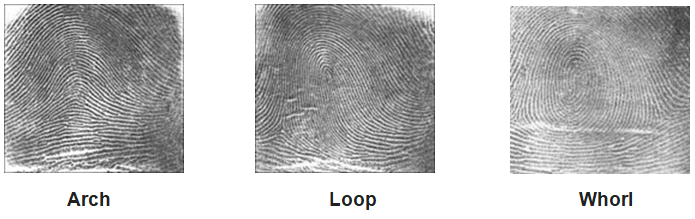
The three basic patterns of fingerprint ridges are the arch, loop, and whorl:
- Arch: The ridges enter from one side of the finger, rise in the center forming an arc, and then exit the other side of the finger.
- Loop: The ridges enter from one side of a finger, form a curve, and then exit on that same side.
- Whorl: Ridges form circularly around a central point on the finger.
Scientists have found that family members often share the same general fingerprint patterns, leading to the belief that these patterns are inherited
3 Basic Types Of Fingerprint
Fingerprint Verification
Minutiae Extracting
Minutiae Features
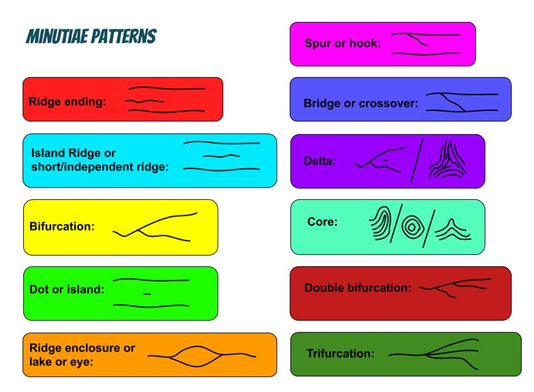
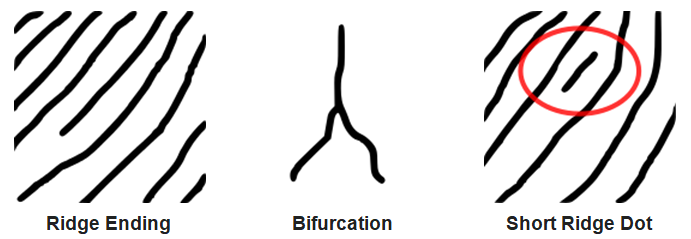
Features of Fingerprint Ridges, called Minutiae, include
- Ridge Ending – The abrupt end of a ridge
- Bifurcation – A single ridge dividing in two
- Short or Independent Ridge – A ridge that commences, travels a short distance and then ends
- Island or Dot – A single small ridge inside a short ridge or ridge ending that is notconnected to all other ridges
- Lake or Ridge Enclosure – A single ridge that bifurcates and reunites shortly afterward to continue as a single ridge
- Spur – A bifurcation with a short ridge branching off a longer ridge
- Bridge or Crossover – A short ridge that runs between two parallel ridges
- Delta – A Y-shaped ridge meeting
- Core – A circle in the ridge pattern
Fingerprint Classification System
Before computerization, manual filing systems were used in large fingerprint repositories.[5] A fingerprint classification system groups fingerprints according to their characteristics and therefore helps in the matching of a fingerprint against a large database of fingerprints. A query fingerprint that needs to be matched can therefore be compared with a subset of fingerprints in an existing database.[2] Early classification systems were based on the general ridge patterns, including the presence or absence of circular patterns, of several or all fingers. This allowed the filing and retrieval of paper records in large collections based on friction ridge patterns alone. The most popular systems used the pattern class of each finger to form a numeric key to assist lookup in a filing system. Fingerprint classification systems included the Roscher System, the Juan Vucetich System and the Henry Classification System. The Roscher System was developed in Germany and implemented in both Germany and Japan. The Vucetich System was developed in Argentina and implemented throughout South America. The Henry Classification System was developed in India and implemented in most English-speaking countries.[5]
In the Henry Classification System there are three basic fingerprint patterns: loop, whorl, and arch,[6] which constitute 60–65 percent, 30–35 percent, and 5 percent of all fingerprints respectively.[citation needed] There are also more complex classification systems that break down patterns even further, into plain arches or tented arches,[5] and into loops that may be radial or ulnar, depending on the side of the hand toward which the tail points. Ulnar loops start on the pinky-side of the finger, the side closer to the ulna, the lower arm bone. Radial loops start on the thumb-side of the finger, the side closer to the radius. Whorls may also have sub-group classifications including plain whorls, accidental whorls, double loop whorls, peacock’s eye, composite, and central pocket loop whorls.[5]
The system used by most experts, although complex, is similar to the Henry Classification System. It consists of five fractions, in which R stands for right, L for left, i for index finger, m for middle finger, t for thumb, r for ring finger and p(pinky) for little finger. The fractions are as follows:
Ri/Rt + Rr/Rm + Lt/Rp + Lm/Li + Lp/Lr
The numbers assigned to each print are based on whether or not they are whorls. A whorl in the first fraction is given a 16, the second an 8, the third a 4, the fourth a 2, and 0 to the last fraction. Arches and loops are assigned values of 0. Lastly, the numbers in the numerator and denominator are added up, using the scheme:
(Ri + Rr + Lt + Lm + Lp)/(Rt + Rm + Rp + Li + Lr)
A 1 is added to both top and bottom, to exclude any possibility of division by zero. For example, if the right ring finger and the left index finger have whorls, the fraction used is:
0/0 + 8/0 + 0/0 + 0/2 + 0/0 + 1/1
The resulting calculation is:
(0 + 8 + 0 + 0 + 0 + 1)/(0 + 0 + 0 + 2 + 0 + 1) = 9/3 = 3