
The foundation
The DISC Model of Behaviour was first proposed in 1928 by William Moulton Marston, a physiological psychologist, in his book Emotions of Normal People. Psychologists have been measuring personality traits since the 1930s. Since that time they have strived to better understand personality and to create ways of measuring it. They have become more aware of the complexity of interactive forces that are responsible for individuals behaviour. DISC personality assessment determines the emotional health of individuals. DISC is used to help people understand themselves and others in the range of normal human behaviour’s.
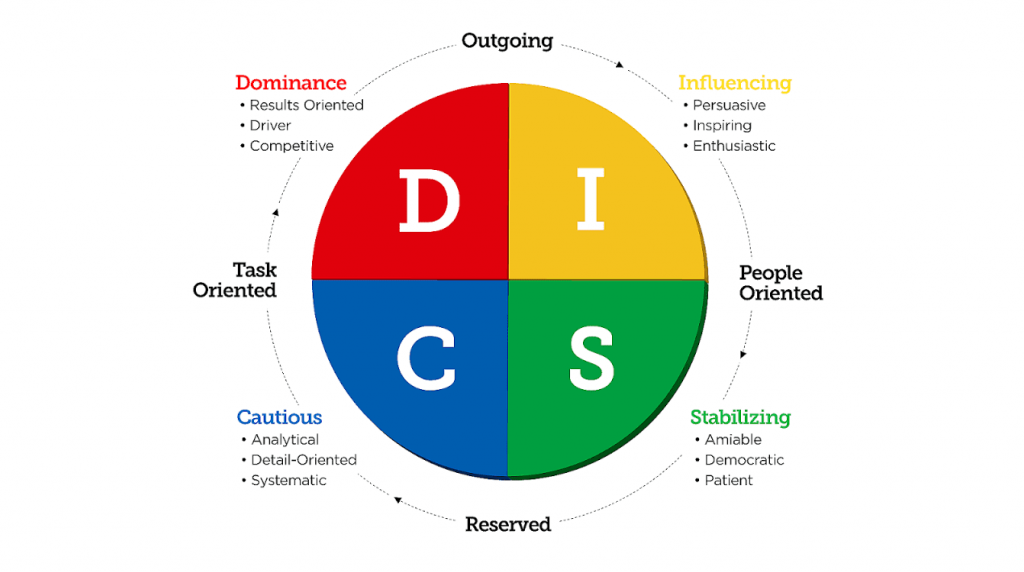
DISC is a behavior assessment tool based on the DISC theory of psychologist William Moulton Marston, which centers on four different personality types. From his research, Marston theorized that the behavioural expression of emotions could be categorized into four primary types, stemming from the person’s perceptions of self in relationship to their environment. These four types were labelled by Marston as Dominance (D), Inducement (I), Submission (S), and Compliance (C). He created a model that integrated these four types of emotional expression into a two-dimensional, two-axis space.
Deepen your understanding of yourself and others
What does DISC mean.
DISC is an acronym that stands for the four main personality profiles described in the DISC model
- D – Dominance
- I – Influence
- S – Steadiness
- C – Conscientiousness
People with D personalities tend to be confident and place an emphasis on accomplishing bottom-line results.
People with I personalities tend to be more open and place an emphasis on relationships and influencing or persuading others.
People with S personalities tend to be dependable and place the emphasis on cooperation and sincerity.
People with C personalities tend to place the emphasis on quality, accuracy, expertise, and competency.
What does DISC measure
DISC measures dimensions of your personality. It does not measure intelligence, aptitude, mental health, or values. DISC profiles describe human behaviour in various situations—for example, how you respond to challenges, how you influence others, your preferred pace, and how you respond to rules and procedures. It measures tendencies and preferences, or patterns of behaviour, with no judgment regarding value or alignment with a skill set or job classification. DISC is a tool for dialogue, not diagnosis.
DISC broadly measures four aspects of personality: dominance (D), influence (I), steadiness (S), and conscientiousness (C). These are the foundational traits from the original DISC model.
DISC expands on these four quadrants, providing greater insight for specific purposes (Managing others, Leadership, Sales, or Conflict, for example). DISC measures eight scales (D, iD/Di, i, iS/Si, S, SC/CS, C, and CD/DC) as well as priorities during the assessment process.