

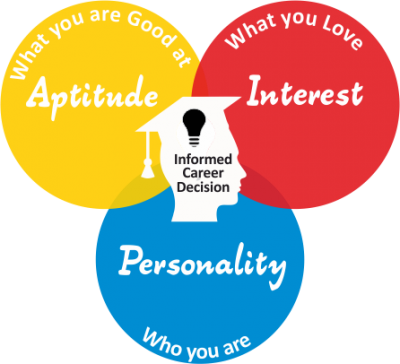
Career guidance help students understand their strengths and weaknesses and then match them with their Skills and Interest so that they get the best suitable career choices. It assist’s an individual in making and implementing informed educational and occupational choices. In simple words, it is a journey in which people develop to make mature and informed decisions

Career Guidance Test is a study of Multiple Intelligence invented by Dr. Howard Gardner. According to Dr Gardner there are Nine types of Multiple Intelligence. Each Individual has Nine intelligences, although the proportion may vary. It’s essential to know regarding these Multiple Intelligences. So that we can continue to acquire & sharpen the ones we are already very good at, and be able to improve the other Multiple Intelligence. All these multiple intelligence will define the Career Personality Test.

Importance of DMIT Test IN Career Guidance

  • Know Your Personality Types.
  • Develop your Core Competencies.
  • Recognize your Multiple Intelligence.
  • Know your Strength and Weakness based on MI Theory.
  • Find the most suitable Learning Style.
  • Know your Inborn Talents, Potential & Personality Type.
  • Understand your best Learning Methodology & achieve Academic Success
  • Choose Right Academic Stream based on Inborn Talent & Multiple Intelligence.
  • Choose Right Career & achieve Exponential growth
  • Understand your Relationship Compatibility through DMIT
  • Manage your Stress through DMIT

Know your Five dimensional career assessment with the help of DMIT based on

  • Personality Analysis
  • Career Interest Analysis
  • Career Motivators Analysis
  • Learning Style Analysis
  • Skills & Abilities Analysis

Gardner’s Theory of Multiple Intelligences

When you hear the word intelligence, the concept of IQ testing may immediately come to mind. Intelligence is often defined as our intellectual potential; something we are born with, something that can be measured, and a capacity that is difficult to change.

In recent years, however, other views of intelligence have emerged. One such conception is the theory of multiple intelligences proposed by Harvard psychologist Howard Gardner.

Theory of Multiple Intelligences

This theory suggests that traditional psychometric views of intelligence are too limited. Gardner first outlined his theory in his 1983 book Frames of Mind: The Theory of Multiple Intelligences, where he suggested that all people have different kinds of “intelligences.”

Gardner proposed that there are eight intelligences, and has suggested the possible addition of a ninth known as “existentialist intelligence.”1

In order to capture the full range of abilities and talents that people possess, Gardner theorizes that people do not have just an intellectual capacity, but have many kinds of intelligence, including musical, interpersonal, spatial-visual, and linguistic intelligences.

While a person might be particularly strong in a specific area, such as musical intelligence, he or she most likely possesses a range of abilities. For example, an individual might be strong in verbal, musical, and naturalistic intelligence.

Career Guidance Based on Multiple Intelligence

Visual Spatial Intelligence

People who are strong in visual-spatial intelligence are good at visualizing things. These individuals are often good with directions as well as maps, charts, videos, and pictures.

Characteristics

People with visual-spatial intelligence:

  • Read and write for enjoyment
  • Are good at putting puzzles together
  • Interpret pictures, graphs, and charts well
  • Enjoy drawing, painting, and the visual arts
  • Recognize patterns easily

Linguistic-Verbal Intelligence

People who are strong in linguistic-verbal intelligence are able to use words well, both when writing and speaking. These individuals are typically very good at writing stories, memorizing information, and reading.

Characteristics

People with linguistic-verbal intelligence:

  • Remember written and spoken information
  • Enjoy reading and writing
  • Debate or give persuasive speeches
  • Are able to explain things well
  • Use humor when telling stories

Logical-Mathematical Intelligence

People who are strong in logical-mathematical intelligence are good at reasoning, recognizing patterns, and logically analyzing problems. These individuals tend to think conceptually about numbers, relationships, and patterns.

Characteristics 

People with logical-mathematical intelligence:

  • Have excellent problem-solving skills
  • Enjoy thinking about abstract ideas
  • Like conducting scientific experiments
  • Can solve complex computations

Bodily-Kinesthetic Intelligence

Those who have high bodily-kinesthetic intelligence are said to be good at body movement, performing actions, and physical control. People who are strong in this area tend to have excellent hand-eye coordination and dexterity.

Characteristics

People with bodily-kinesthetic intelligence:

  • Are skilled at dancing and sports
  • Enjoy creating things with his or her hands
  • Have excellent physical coordination
  • Remember by doing, rather than hearing or seeing

Musical Intelligence

People who have strong musical intelligence are good at thinking in patterns, rhythms, and sounds. They have a strong appreciation for music and are often good at musical composition and performance.

Characteristics

People with musical intelligence:

  • Enjoy singing and playing musical instruments
  • Recognize musical patterns and tones easily
  • Remember songs and melodies
  • Have a rich understanding of musical structure, rhythm, and notes

Interpersonal Intelligence

Those who have strong interpersonal intelligence are good at understanding and interacting with other people. These individuals are skilled at assessing the emotions, motivations, desires, and intentions of those around them.

Characteristics

People with interpersonal intelligence:

  • Communicate well verbally
  • Are skilled at nonverbal communication
  • See situations from different perspectives
  • Create positive relationships with others
  • Resolve conflicts in group settings

Intrapersonal Intelligence

Individuals who are strong in intrapersonal intelligence are good at being aware of their own emotional states, feelings, and motivations. They tend to enjoy self-reflection and analysis, including daydreaming, exploring relationships with others, and assessing their personal strengths.

Characteristics

People with intrapersonal intelligence:

  • Analyze their strengths and weaknesses well
  • Enjoy analyzing theories and ideas
  • Have excellent self-awareness
  • Understand the basis for his or her own motivations and feelings

Naturalistic Intelligence

Naturalistic is the most recent addition to Gardner’s theory and has been met with more resistance than his original seven intelligences. According to Gardner, individuals who are high in this type of intelligence are more in tune with nature and are often interested in nurturing, exploring the environment, and learning about other species. These individuals are said to be highly aware of even subtle changes to their environments.

Characteristics

People with naturalistic intelligence:

  • Are interested in subjects such as botany, biology, and zoology
  • Categorize and catalog information easily
  • Enjoy camping, gardening, hiking, and exploring the outdoors
  • Dislikes learning unfamiliar topics that have no connection to nature