
Learning Styles
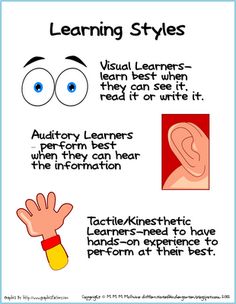 Technically, an individual’s learning style refers to the preferential way in which an individual absorbs, processes, comprehends and retains information. Every individual has different methods of absorbing information. Understanding an individual’s Learning Style makes learning easy, enjoyable & effective. Individual learning styles depend on cognitive, emotional and environmental factors, Every Individual is different & its important to understand how each individual processes data.
For example, when learning how to build a block, some students understand the process by following verbal instructions, while others have to physically manipulate the block themselves. This notion of individualized learning styles has gained widespread recognition in education theory and classroom management strategy. It is important for educators to understand the differences in their students’ learning styles, so that they can implement best practice strategies.
The Learning Style is intended to help an employee or a student to “understand how their learning style impacts upon problem solving, teamwork, handling conflict, communication and career choice, develop more learning flexibility, find out why teams work well—or badly—together; strengthen their overall learning
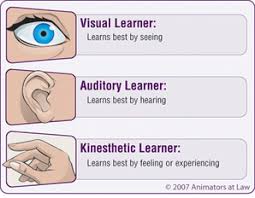 Let us understand different types of Learning Styles. By understanding what kind of learner you are, you can gain a better perspective on how to implement these learning styles
| Descriptions of Learning Styles | ||
| Visual | Kinesthetic / Tactile | Auditory |
| Picture | Gestures | Listening |
| Shape | Body movements | Rhythms |
| Sculpture | Object manipulation | Tone |
| Paintings | Positioning | Chants |
Visual Learning
Visual learning is a learning style in the Fleming VAK model where a learner needs to see information in order to process it. Visual Learners can utilize graphs, charts, maps, diagrams, and other forms of visual stimulation to effectively interpret information. Students who best internalize and synthesize information when it is presented to them in a graphic depiction of meaningful symbols are described as visual learners. They may respond to arrows, charts, diagrams and other visualizations of information hierarchy, but not necessarily to photographs or videos.2
Because visual learners tend to be holistic learners who process information best when it is presented to them as a robust whole rather than piecemeal, they tend to see positive educational outcomes when they are presented with summarizing charts and diagrams rather than sequential slides of information.3
Auditory Learning
Auditory learning is a learning style in which a person learns through listening. An auditory learner depends on listening and speaking as a main way of learning. Auditory learners must be able to hear what is being said in order to understand and may have difficulty with instructions that are drawn but if the writing is in a logical order it can be easier to understand. They also use their listening and repeating skills to sort through the information that is sent to them. They are good listeners when people speak. Auditory (or aural) learners are most successful when they are given the opportunity to hear information presented to them vocally. Because students with this learning style may sometimes opt not to take notes during class in order to maintain their unbroken auditory attention, educators can erroneously conclude that they are less engaged than their classmates. However, these students may simply have decided that note-taking is a distraction and that their unbroken attention is a more valuable way for them to learn.4
Auditory learning is a two-way street: Students who fall into this modality often find success in group activities where they are asked to discuss course materials vocally with their classmates, and they may benefit from reading their written work aloud to themselves to help them think it through.2
Kinesthetic Learning
Kinesthetic learning or tactile learning is a learning style in which learning takes place by the students carrying out physical activities, rather than listening to a lecture or watching demonstrations. As cited by Favre (2009), Dunn and Dunn defined kinesthetic learners as students who require whole-body movement to process new and difficult information. Kinesthetic learners are hands-on, participatory learners who need to take a physically active role in the learning process in order to achieve their best educational outcomes. They are sometimes referred to as “tactile learners,” but this can be a bit of a misnomer; rather than simply utilizing touch, kinesthetic learners tend to engage all of their senses equally in the process of learning.6
Because of their active nature, kinesthetic learners often have the most difficult time succeeding in conventional classroom settings. Some educators have found success encouraging kinesthetic learners to utilize flashcards for subjects like math and English to make rote memorization into an interactive experience. These students also often thrive in scientific subjects with lab components, as the skills-based, instructional training that occurs in these settings engages them in productive ways.6
Swot Strategies
Referred to as SWOT (“Study Without Tears”), Flemings provides advice on how students can use their learning modalities and skills to their advantage when studying for an upcoming test or assignment.
Visual SWOT Strategies
- Utilize graphic organizers such as charts, graphs, and diagrams.
- Redraw your pages from memory.
- Replace important words with symbols or initials.
- Highlight important key terms in corresponding colors.
Auditory SWOT Strategies
- Record your summarized notes and listen to them on tape.
- Talk it out. Have a discussion with others to expand upon your understanding of a topic.
- Reread your notes and/or assignment out loud.
- Explain your notes to your peers/fellow “aural” learners.
Kinesthetic SWOT Strategies
- Use real life examples, applications and case studies in your summary to help with abstract concepts.
- Redo lab experiments or projects.
- Utilize pictures and photographs that illustrate your idea.
Can an Individual have different Learning Styles ?
Studies prove that somewhere between 50 and 70 percent of the population have affinities to different styles of learning. These people are called “multimodal learners” and tend to succeed in classroom settings that engage them with multiple learning styles alternately or in concert with one another.
Just because students can succeed with different learning styles does not necessarily mean that they should be engaged with more than one on most occasions, however. While today’s media-rich environment has made multimodal learning easier than ever before, recent studies recommend some caution and care when introducing multimedia instructional design into the classroom. Generally speaking, multimedia should be treated thoughtfully as a means to a specific educational goal rather than an end itself, and multimodal, interactive instruction should be reserved for more complex topics than for basic memorization and skill-building