
HISTORY OF FINGERPRINT AND DERMATOGLYPHICS RESEARCH
Discover your child’s hidden talent & potential
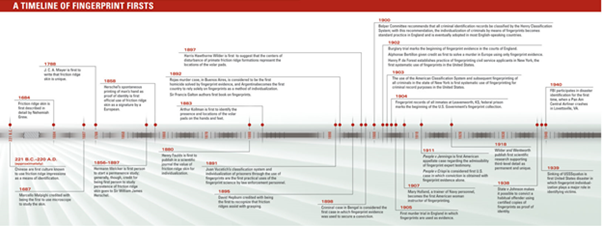
Development of Dermatoglyphics Research & FINGERPRINT HISTORY
1684 Dr Nehemiah Grew (1641-1712)
Presented Finger Prints, Palms and Soles An Introduction To Dermatoglyphics to the Royal Society.
1685 Dr.Bidloo
Published an anatomical atlas, Anatomia Humani Corporis, with illustrations showing the human figure both in living attitudes and as dissected cadavers.
1686 Dr. Marcello Malphigi (1628-1694)
Noted in his treatise; ridges, spirals and loops in fingerprints.
1788 J.C.Mayer
Was the first to write out basic tenets of fingerprint analysis and theorised that fingerprints were unique.
1823 John E. Purkinji
Professor of anatomy at the University of Breslau published his research on fingerprint pattern classification, consisting of nine print categories. Czech Republic’s physicist and biologist Johannes Evangelista Purkinje started to study the protruding lines on the skin of the human palm and the sole and attempted to systemize as well as find the relationship between these prints and the human kind. Dr. Jan Purkinje classified the papillary lines on the fingertips into nine types: arch, tented arch, ulna loop, radial loop, peacock’s eye/compound, spiral whorl, elliptical whorl, circular whorl, and double loop/composite.
1880 Professor Henry Faulds & Professor WJ Herschel
The Nature journal published two articles that recommended the use of fingerprints/ Dermatoglyphics as a way to uniquely identify and differentiate mankind
1892 Sir Francis Galton
A British Anthropologist cousin of Charles Darwin. He published his first landmark publication “Finger Prints” scientifically establishing the individuality and permanence of fingerprints. The book included the first practical classification system of fingerprint identification, responsible for basic nomenclature (arch, loop, whorl), Opening the door for further research in Dermatoglyphics.
1920 Elizabeth Wilson
Started analysing the status of the brain scientifically in the University of Columbia by using statistics to check the difference between people with schizophrenia, low intelligence and normal people.
1926 Dr Harold Cummins, M.D The Father of Dermatoglyphics
Studied all aspects of fingerprint analysis, from anthropology to genetics to embryology & established the theory of Dermatoglyphics in 1926 after researching on existing research with other scientists, standardizing the definition of Dermatoglyphics which is commonly used today. Dermatoglyphics was officially acknowledged in the field of research. Harold Cummins, M.D. aka. the Father of Dermatoglyphics.& C Midlo, M.D.studied all aspects of fingerprint analysis, from anthropology to genetics and embryology perspective. 1943 Published book, Finger Prints, Palms and Soles, a bible in the field of Dermatoglyphics. Hence, Dermatoglyphics officially became a professional research area of knowledge.
1930 Society for the Study of Physiological Patterns
Started the study of the five types of fingerprints and their unique personality traits (SSPP Physiology society).
1936 Dr. Harold Cummins & Dr. Charles Midlo
Researched the embryo-genesis of skin ridge patterns and established that the fingerprint patterns actually develops in the womb and are fully formed by the fourth foetal month.
1944 Dr. Julius Spier
Published the hands of children and analyzed children’s psychological personality development using the Dermatoglyphics method. Dr. Julius Spier Psycho-Analytic Chirologist published The Hands of Children he made several significant discoveries especially in the area of psycho-sexual development and the diagnosis of imbalances and problems in this area from the patterns of the hands.
1950 Dr. Penfield
Canadian brain surgeon professor pointed out the close link and relationship between Fingerprints and the Brain. He published Body of all parts of the brain associated with the cross-section map, also shows a finger dermatology and close association between the brain.
1958 Noel Jaquin
Researched and found that each fingerprints corresponds to each type of personality.
1968 Sarah Holt
‘The Genetics of Dermal Ridges’ published in 1968, Summarizes her research in dermatoglyphics patterns of both the fingers and the palm in various people, both normal and congenitally afflicted.
1969 John J. Mulvihill, MD and David W. Smith, MD
Published The Genesis of Dermatoglyphics that provides the most up to date version of how fingerprints form.
1970 USSR
Former Soviet Union. Used Dermatoglyphics in selecting the contestants for Olympics. They have used Dermatoglyphics as one of the methods to select candidates for Olympics Games since the 1970’s. As it turned out, the USSR took home 50 gold medals in 1972 and 125 in 1976.
1980’s China
Carried out research work on human potential, intelligence and talents through dermatoglyphics and human genome perspective.
1981 Professor Roger W. Sperry
He and his research partners were awarded the Nobel prize for Biology in their contribution towards the functions of the right brain and left brain as well as the dual brain theory. Research related to the brain enters its peak at this stage. At the same time, it is now widely used by scientists from various other fields
1985 Dr. Chen Yi Mou PhD – Harvard University – Research in Dermatoglyphics
Based on Multiple Intelligence theory of Dr. Howard Gardner, First applied dermatoglyphics to educational fields and brain physiology.
1987-1993 Fitz Herbert
The significant figure for scholastic research for skin grains, Fitz Herbert published over 300 thesis on the relationship of Dermatoglyphics, Anthropology, Anatomy and Medical field.
Fingerprint History
2000 Dr Stowens
Chief of Pathology at St Luke’s hospital in New York, claims to be able to diagnose schizophrenia and leukaemia with up to a 90% accuracy. In Germany, Dr Alexander Rodewald reports he can pinpoint many congenital abnormalities with a 90% accuracy.
2004 IBMBS International Behavioural & edical Biometric Society
IBMBS- International Behavioural & Medical Biometrics Society. Over 7000 reports and thesis published. Nowadays the U.S., Japan or China, Taiwan apply dermatoglyphics to educational fields, expecting to improve teaching qualities and raising learning efficiency by knowing various learning styles.
2005 Prof Lin
Filed for the Patent for Dermatoglyphics test
2008 Prof Lin
Prof Lin was awarded U.S Patent for his unique concept on DMIT
Dermatoglyphics in Recent History
Although many important discoveries regarding the psychological significance of fingerprint patterns have been made, the main thrust of scientific dermatoglyphic research in the latter half of the twentieth century has been directed into genetic research and the diagnosis of chromosomal defects. Over the last thirty years or so, more than four thousand papers have been written on the significance of skin-ridge patterns!
The published work includes the frequencies of various patterns, for personal identification, Inheritance, anomalous patterns, medico-legal cases etc. Some of the authors who have made a significant contribution are given below: Faulds (1905), Hellwig (1912), Carriere (1923). Ganther (1923), Roscher (1925), Furuhata (1927). Heindl (1927), Bonnevie (1929), Cummins (1930, 1934, 1961), Metiner (1930), Gerke (1932), Harster (1932), Saller (1932), Abel (1933, 1935), Geipel (1935, 1937), Kirchmair (1936), Csik (1927), Henry (1937), MacArther (1937), Pol (1937), Dankmeijer (1938), de Pina (1939), Okuma (1940), Kumbnani (1959, 1968, 1972, 1978, 1984, 1990, 1991, 2005), Singh (1961), Volotzkoy (1961), Bali (1968), Sen (1968), Clercil (1969), Bhanu (1975) Mavalwala (1977), Singh and Bhasin (1979), Livshits (1987), Micle (1988), Kamali (1990), Bhasin and Walter (2001).